
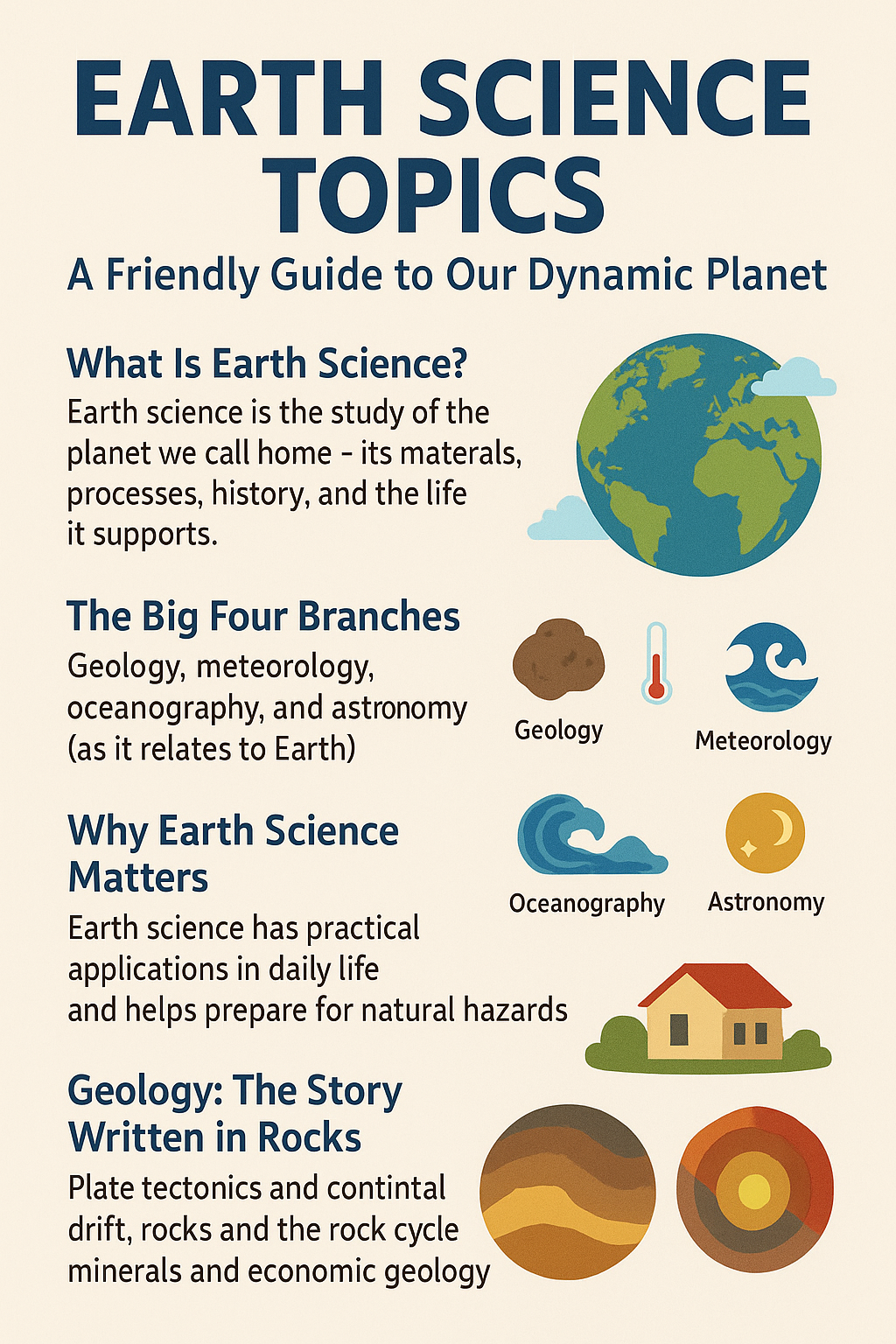

Earth science is one of the most fascinating fields of study because it helps us understand the very planet we live on—its structure, its natural processes, and the forces that shape our daily lives. From the movement of continents to the patterns in the atmosphere, every element of Earth science reveals a story about how our world works. Whether you’re curious about volcanoes, climate, oceans, rocks, or even the solar influences that affect Earth, exploring these topics opens the door to deeper knowledge of nature and our environment. In this article, we’ll break down the most important Earth science topics in a simple, engaging way, helping you appreciate the dynamic planet beneath your feet.
What Is Earth Science?
Earth science is the study of the planet we call home — its materials, processes, history, and the life it supports. Think of it as a giant, multidisciplinary detective story: scientists collect clues from rocks, air, water, living things, and space to piece together how Earth works and how it’s changing. At its core, Earth science helps us understand the physical systems that shape landscapes, control weather, and sustain ecosystems.
The Big Four Branches
- Geology: The study of Earth’s solid parts — rocks, minerals, mountains, and the forces that build and break them.
- Meteorology: The science of the atmosphere — weather, storms, and climate patterns.
- Oceanography: Everything about oceans — currents, chemistry, marine life, and how oceans interact with atmosphere and land.
- Astronomy (as it relates to Earth): How Earth fits into the wider cosmos — tides, solar influences, and comparative planetology.
Why Earth Science Matters
Earth science isn’t just for textbooks. It plays a vital role in daily life: predicting storms, locating water, finding mineral resources, and planning cities. It helps us prepare for natural hazards (like earthquakes and floods) and informs policies on climate change, conservation, and resource use. In short, understanding Earth science helps us live smarter and safer on a changing planet.
Practical Applications in Daily Life
From weather forecasts that help plan your week to geological surveys that guide safe building projects, Earth science shows up in many ways — sometimes quietly, sometimes dramatically during disasters.
Preparing for Natural Hazards
Studying past earthquakes, volcanoes, and extreme weather helps communities design better infrastructure and early warning systems. Prevention and preparation often save lives.
Geology: The Story Written in Rocks
Geology reads Earth’s past like chapters in a book. Folded mountain ranges, buried fossils, and mineral veins tell us about collisions, climate shifts, and ancient oceans.
Plate Tectonics and Continental Drift
Imagine Earth’s outer shell as a jigsaw puzzle of moving plates. The theory of plate tectonics explains earthquakes, mountain building, and volcanic activity. When plates collide, one may dive under another (subduction); when they separate, new crust forms.
Rocks and the Rock Cycle
Rocks change forms: igneous (from molten rock), sedimentary (from compacted layers), and metamorphic (transformed by heat and pressure). The rock cycle is Earth’s slow, geological recycling program.
Minerals and Economic Geology
Minerals are the building blocks of rocks and critical resources. Geologists map mineral deposits that supply metals, building materials, and industrial minerals.
Meteorology: Weather vs. Climate
Weather is what you get day-to-day; climate is weather averaged over decades. Meteorology deciphers air patterns, how storms develop, and why climates shift.
Weather Fundamentals
Temperature, pressure, humidity, and wind are the main players. Their interactions create everything from pleasant breezes to powerful cyclones.
Climate Change and Long-Term Trends
Earth’s climate has always changed, but recent human-driven changes are fast enough to affect ecosystems, agriculture, and cities. Carbon dioxide, methane, and land-use changes alter the energy balance of the planet.
Severe Weather
Understanding the mechanics of hurricanes, tornadoes, and floods helps meteorologists issue warnings and reduce harm.
Oceanography: The Heart of Earth’s Climate System
Oceans absorb heat and carbon, drive weather through currents, and host vast ecosystems. Being “blue” is more than scenic — it’s essential for global balance.
Ocean Currents and Thermohaline Circulation
Currents like the Gulf Stream move warm water across the globe. Deep-water circulation, driven by temperature and salinity (thermohaline), acts like a planetary conveyor belt influencing climate.
Marine Ecosystems and Biodiversity
From coral reefs to the deep sea, oceans teem with life. These systems supply food, regulate chemistry, and house species we’re still discovering.
Sea Level Rise and Coastal Changes
Melting ice and thermal expansion cause sea levels to climb, reshaping coastlines and affecting millions who live near the shore.
Earth’s Systems: Interaction Is Everything
Earth’s spheres — geosphere (land), hydrosphere (water), atmosphere (air), biosphere (life) — are tightly linked. Change in one triggers ripples elsewhere.
Feedback Loops and Tipping Points
Some interactions accelerate change: for example, melting ice exposes darker ocean, which absorbs more heat and melts more ice. These feedbacks can push the system toward new states.
Environmental Earth Science and Human Impact
Human activity alters Earth’s systems — from polluting waterways to extracting resources. Environmental earth science studies these impacts and seeks sustainable solutions.
Pollution and Its Pathways
Pollutants travel through air, water, and soil, sometimes concentrating in food chains. Mapping these pathways helps design mitigation strategies.
Resource Management and Sustainability
Balancing resource extraction with conservation is crucial. Earth scientists inform policies for water use, mining, and land planning.
Tools & Methods in Earth Science
Modern earth scientists use a mix of fieldwork, instruments, and computation to understand complex systems.
Remote Sensing and Satellites
Satellites monitor weather, land cover, sea surface temperature, and more — enabling global-scale observations that were once impossible.
Fieldwork and Sampling
Geologists still walk the land, collect rock samples, measure streams, and observe phenomena in situ. Fieldwork is where theory meets reality.
Modeling and Data Analysis
Computers simulate climate, earthquakes, and ocean circulation. Models are simplified representations but crucial for forecasting and testing ideas.
Hot Topics & Emerging Areas
Earth science is evolving, tackling cutting-edge questions.
Geoengineering
Proposed technologies aim to deliberately alter Earth’s climate — from reflecting sunlight to removing carbon. These raise complex technical and ethical issues.
Paleoclimatology and Ancient Climates
Studying ice cores, tree rings, and sediments reveals past climates, providing context for current changes.
Planetary Comparisons
Comparing Earth with Mars, Venus, and moons helps reveal what makes Earth habitable and shows other planets’ geologic stories.
How to Explore Earth Science Yourself
Curiosity is the best lab.
Citizen Science Projects
Projects like local weather stations, biodiversity surveys, and earthquake reporting let anyone contribute valuable data.
Simple Home Experiments
DIY projects — tracking temperature, building a simple seismometer, or observing erosion in a sandbox — teach scientific thinking.
Careers in Earth Science
If you love the outdoors and science, Earth science offers diverse careers.
Typical Roles and What They Do
- Geologist: maps and studies rocks and hazards.
- Meteorologist: forecasts weather and studies climate.
- Oceanographer: studies seas and marine processes.
- Environmental Scientist: assesses human impacts and remediation.
Skills and Education Pathways
A mix of field skills, data analysis, and communication is valuable. Degrees vary from bachelor’s to PhDs depending on the role.
Teaching Earth Science: Tips for Educators
Make it tangible and visual.
Using Stories and Visuals
Narratives (like the life of a raindrop) and maps make concepts stick.
Field Trips and Hands-On Learning
Hands-on experiences — visiting a coast, rock outcrop, or weather station — turn abstract ideas into memorable lessons.
Fun Facts and Myths about Earth
Common Misconceptions
- Myth: Seasons are caused by Earth being closer to the Sun. (Truth: tilt of the axis is the main cause.)
- Myth: Earth’s interior is molten lava from top to bottom. (Truth: it’s layered; some parts are solid.)
Surprising Earth Records
- The deepest point: Challenger Deep in the Mariana Trench.
- Tallest mountain (from base): Mauna Kea measured from the ocean floor.
Conclusion
Earth science is a vast, exciting field that connects rocks, oceans, air, and life into a single, dynamic story. Whether your interest is understanding a local flood, forecasting next week’s weather, studying ancient climates, or planning a career, Earth science gives you the tools to explore the planet responsibly. It’s both practical and awe-inspiring — a science that helps us protect our home and imagine our place in the cosmos.
FAQs
Q1: What are the simplest ways to start learning earth science on my own?
Start with local observations: keep a weather diary, collect and label rocks, visit a nearby river or coastline, and use free online courses and citizen science apps.
Q2: How does geology affect daily life?
Geology influences soil quality for farming, availability of groundwater, building safety, and the presence of mineral resources — all of which shape communities and economies.
Q3: Can Earth science help predict earthquakes?
While long-term statistical forecasts are improving, precise short-term earthquake prediction remains elusive. Earth scientists use hazard maps and early warning systems to reduce risk.
Q4: What’s the difference between weather and climate?
Weather refers to short-term atmospheric conditions (hours to days). Climate is the long-term average of weather patterns over decades or longer.
Q5: Are careers in earth science in demand?
Yes — especially in areas like environmental consulting, climate adaptation, water resources, and renewable energy. Demand grows with emphasis on sustainability and hazard mitigation.