
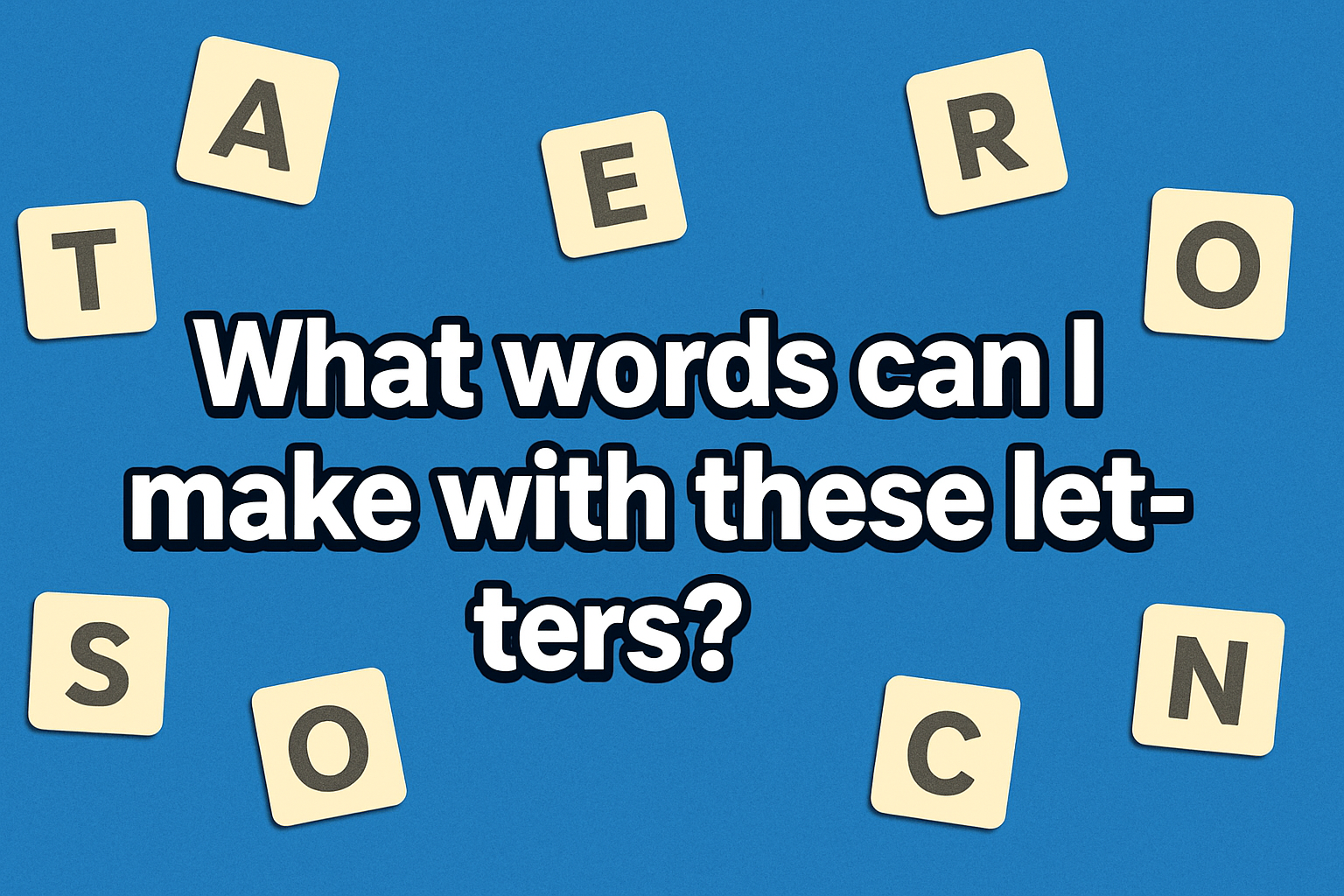

Why We Love Rearranging Letters
Whether you’re playing Scrabble, solving a puzzle, or trying to win a mobile word game, you’ve probably asked yourself, “What words can I make with these letters?” It’s a universal question that millions of people search for daily. Building words from random letters is fun, surprisingly challenging, and great for sharpening your mind.
Understanding Letter Scrambles and Word Formation
What Letter Rearranging Actually Means
Letter rearranging is the process of taking a random set of letters and forming valid English words from them. The goal is to find all possible combinations—short words, long words, and even hidden words.
Common Uses in Games and Puzzles
You’ll use this skill in:
- Scrabble
- Wordscapes
- Word Cookies
- Boggle
- Crossword helpers
- Classroom learning
How to Quickly Find Words From Random Letters
Start With Small Words First
Small words are the quickest to spot. For example, if your letters include A, T, R, E, words like at, are, eat, and tea appear almost instantly.
Look for Common Prefixes and Suffixes
Some of the easiest to find are:
- Prefixes: re-, un-, pre-, up-
- Suffixes: -ed, -ing, -er, -es, -ly
Adding a simple ending can double or triple the number of words you create.
Word Length Categories
2-Letter Words
Two-letter words are essential for games and solving puzzles. Examples include:
up, on, an, it, to, by, me, my
3-Letter Words
These are easier to find once you master the small ones. Examples:
tea, car, run, pen, sun, hat
4-Letter Words and Beyond
With more letters, your possibilities increase dramatically:
rate, care, fire, game, time, star
The longer the word, the more points you earn in most games.
Tricks to Build More Words
Rearranging Vowels and Consonants
Try separating vowels (A, E, I, O, U) from consonants first. Then pair them:
- vowel + consonant (ex: at, be, go)
- consonant + vowel (ex: ta, re, no)
Using “S,” “E,” and “R” to Build More Words
These letters are incredibly powerful because they fit easily into many English word forms:
- pluralizing (cat → cats)
- forming verbs (run → runner)
- extending small words (ate → later)
The Role of Vowels in Creating Words
Why Vowels Matter
Without vowels, you can’t create most English words. A good rule:
More vowels = more possible words.
How To Use Vowel Placement to Maximize Word Options
Try placing vowels in the center of your letter cluster. This makes it easier to form real combinations.
Letter Patterns That Make Word Creation Easier
Common English Patterns
English is full of repeating patterns like:
- th
- sh
- ch
- st
- tr
Spotting patterns quickly helps you unlock more words.
Popular Word Endings
Some endings appear constantly:
- -ing
- -er
- -ed
- -ly
If your letters contain these, you’re already ahead.
Real Examples – Turning Random Letters into Words
Example Set 1
Letters: B, A, T, E
Possible words: bat, tab, eat, tea, beat, beta
Example Set 2
Letters: S, T, O, R, E
Possible words include:
store, rest, rose, sort, sore, to, so, or
Tools That Help You Figure Out “What Words Can I Make With These Letters”
Online Word Generators
These websites let you type in your letters and get instant results.
Mobile Apps for Word-Building Games
Apps like WordFinder and WordSolver help you win word games faster.
Word Games That Use These Skills
Scrabble
Score high by forming longer words or hitting double/triple points.
Wordscapes
Perfect for practicing puzzles with random letters.
Boggle
Boosts your ability to find words fast.
How Word Building Improves Your Brain
Memory Support
Finding words strengthens the part of your brain that handles memory and focus.
Vocabulary Expansion
You naturally learn new words and meanings while solving puzzles.
Common Mistakes People Make When Rearranging Letters
- Focusing only on long words
- Ignoring two-letter words
- Not rechecking letters for additional possibilities
- Forgetting plurals
Tips to Get Faster at Word Creation
- Practice daily
- Start small
- Look for word endings
- Group letters by vowel and consonant
- Use apps to train your mind
Conclusion – Mastering the Art of Word Formation
When you ask, “What words can I make with these letters?” you’re opening the door to creativity, critical thinking, and better vocabulary. The more you practice, the faster you get. Whether for fun or competition, mastering the skill of word-building can upgrade your gaming performance and sharpen your mind for everyday life.
FAQs
1. What’s the easiest way to find words from letters?
Start with small words, separate vowels, and look for common word patterns.
2. Do online word generators help?
Yes, they instantly show all possible combinations and save time.
3. Is rearranging letters good for the brain?
Absolutely! It improves memory, focus, and problem-solving skills.
4. What letters make the most words?
Letters like S, E, R, T, A, O produce a large number of combinations.
5. Can I use this technique for Scrabble?
Yes. It’s one of the best ways to score high points and win consistently.